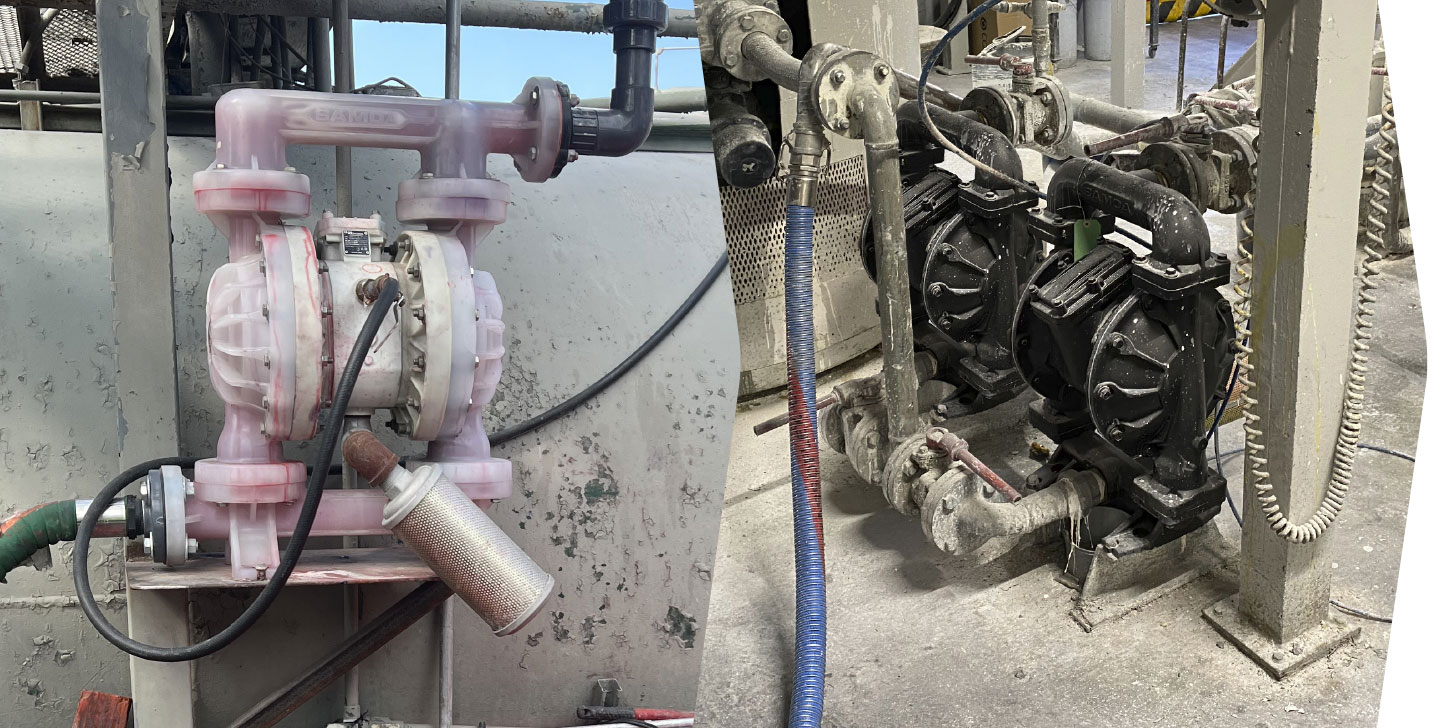
How diaphragm pumps work and why they fail
Diaphragm pumps move fluid through a reciprocating elastomeric membrane that alternately expands and contracts within a sealed chamber. This oscillation creates a pressure differential: suction draws media inward, while compression forces it outward through check valves. The result is a highly adaptable pumping mechanism capable of handling viscous liquids, slurries, and chemically aggressive substances with notable precision.
At the core of the system are the pump diaphragms, inlet and outlet check valves, a fluid chamber, manifold connections, and—depending on design—either a mechanical drive or compressed air distribution system. Each component must remain in exact alignment. Even minor deformation, valve fouling, or membrane fatigue can compromise volumetric efficiency. When a diaphragm pump not pumping issue occurs, root causes often include air leaks, blocked valves, cavitation, or a ruptured diaphragm.
Air-Operated Double Diaphragm pumps use compressed air to drive two diaphragms in a synchronized, alternating cycle. This architecture eliminates the need for electric motors and allows dry running, self-priming, and safer operation in hazardous environments. Still, understanding diaphragm pump pros and cons is essential: while AODD units offer robustness and chemical compatibility, they can also suffer from pulsation, reduced energy efficiency, and wear in air valves over time. If a diaphragm pump not working condition develops, diagnostics should begin with air supply consistency, diaphragm integrity, and valve seat contamination.

Most common diaphragm pump failure modes explained
Diaphragm pumps are engineered for durability, but even robust systems deteriorate under continuous duty, abrasive media, and inconsistent operating conditions. When a diaphragm pump not working scenario occurs, the cause is often mechanical wear rather than sudden catastrophic failure. Identifying the failure mode early reduces downtime, protects upstream equipment, and prevents avoidable maintenance costs.
Understanding diaphragm pump failure modes is critical for maintenance teams to distinguish between minor issues and problems that can escalate quickly.
Diaphragm rupture and material fatigue
A diaphragm pump rupture is one of the most frequent and disruptive faults. Over time, repeated flexing causes elastomer fatigue, particularly when the pump is exposed to aggressive chemicals, excessive discharge pressure, or dry-running conditions. Small fissures often appear before full membrane failure. Once compromised, pump efficiency drops rapidly and fluid containment can be lost.
Check valve and valve seat wear
Valve degradation is another leading source of diaphragm pump common problems. Check balls, flaps, and valve seats wear gradually due to particulate abrasion, scale buildup, or poor fluid compatibility. The symptoms are deceptively simple: reduced flow, erratic suction, and pressure instability. In many cases, the pump still cycles but transfers little or no product.
Air distribution system malfunctions
In air-operated models, the air valve assembly is a common point of attrition. Sticky spool valves, contaminated airlines, and moisture ingress can interrupt diaphragm cycling. The pump may stall intermittently, surge unpredictably, or fail to start altogether. Regular inspection, clean air supply, and scheduled seal replacement remain essential for reliable operation.
Why is your diaphragm pump not pumping?
When a diaphragm pump cycles but fails to move product, the issue is rarely random. In most cases, poor suction conditions, restricted flow paths, or unstable air delivery are undermining pump performance. The good news: these faults are usually diagnosable before they become severe. Fast inspection matters. So does understanding how the system behaves under load.
A blocked suction line is one of the most common causes of flow loss. Debris accumulation, collapsed hose sections, clogged strainers, or improperly sized pipework can all reduce inlet velocity and starve the pump chamber. Once that happens, cavitation may follow. This occurs when vapor pockets form and collapse inside the pump, creating noise, vibration, and erratic discharge.
Fluid viscosity also matters. Thick or temperature-sensitive media can increase suction resistance and impair priming. Even minor restrictions can create disproportionate performance loss in high-cycle applications.
Air-operated diaphragm pumps rely on consistent compressed air to sustain diaphragm stroke length and discharge pressure. If the pump is stalling, surging, or under-delivering, inspect for leaks at fittings, regulators, hoses, and air valves. A pressure drop upstream can dramatically reduce output.
Operators often ask how much air does a diaphragm pump use. The answer depends on pump size, stroke rate, fluid viscosity, discharge head, and duty cycle. Excessive air consumption may indicate internal wear, poor regulation, or inefficient system configuration.
Regular review of diaphragm pump failure modes helps operators anticipate these issues and implement corrective actions before performance drops significantly.
Can diaphragm pumps run dry? Risks and prevention
In many cases, yes—but only within operational limits. While diaphragm pumps are generally more tolerant of dry-running than centrifugal alternatives, that does not make the condition harmless. Short bursts may be acceptable. Prolonged dry operation is not.
In the short term, dry-running may cause little immediate damage, especially in air-operated models designed for intermittent no-flow conditions. Over time, however, the absence of liquid can accelerate thermal stress, elastomer fatigue, valve wear, and internal friction. Performance degradation often begins subtly, then compounds into costly mechanical erosion.
Preventive measures are straightforward but essential. Install dry-run protection sensors where feasible. Monitor suction conditions carefully. Maintain air pressure within manufacturer tolerances, and avoid overspeeding the pump during idle flow conditions. Routine inspection of diaphragms, valve seats, and seals also reduces latent failure risk. When replacement becomes necessary, using high-quality pump diaphragms and replacement accessories ensures consistent performance and minimizes downtime. In industrial service, dry-running should be treated as a temporary exception—not a normal operating state.
Step-by-step diaphragm pump troubleshooting guide
Effective diaphragm pump troubleshooting begins with symptom isolation. If the pump cycles but produces weak or inconsistent flow, start on the fluid side. Inspect suction lines for blockages, collapsed hose, air ingress, or clogged strainers. Then check valve balls, valve seats, and diaphragms for wear, distortion, or contamination. In many cases, successful double diaphragm pump troubleshooting depends on identifying these seemingly minor restrictions before they escalate into full performance loss.
Diagnosing mechanical and fluid-side failures
Examine the wetted path for abrasion, chemical attack, or membrane fatigue. Reduced output, poor priming, and pulsation often indicate compromised internal sealing or valve inefficiency. Also verify that discharge pressure is not exceeding the pump’s operational envelope.
Diagnosing air supply and cycling problems
For air operated double diaphragm pump troubleshooting, evaluate the compressed air system next. Low inlet pressure, moisture contamination, sticky spool valves, and worn air distribution components can interrupt diaphragm reciprocation. A pump that stalls mid-cycle or surges erratically often points to pneumatic instability rather than hydraulic failure.
A methodical inspection sequence saves time, reduces unnecessary part replacement, and restores process reliability faster.
Diaphragm pump failure detection: early warning sings and monitoring
Reliable diaphragm pump failure detection starts long before a pump stops moving fluid. In most industrial environments, failure develops incrementally through wear, imbalance, contamination, or pressure instability. The earliest warning signs are often subtle. Ignoring them is expensive.
Operators should watch for irregular pulsation, reduced discharge consistency, fluid seepage, icing around the air valve, or visible elastomer degradation. These are not cosmetic issues; they are operational signals. Unusual sounds also matter. Clicking, chattering, sputtering, or abrupt cycle-speed changes can indicate valve seat wear, air leakage, cavitation, or diaphragm fatigue.
This is where structured double diaphragm pump troubleshooting becomes valuable. A pump that still runs can still be failing. Monitoring flow rate, cycle frequency, air consumption, and suction behavior often reveals hidden inefficiencies before a full shutdown occurs. For teams responsible for air operated double diaphragm pump troubleshooting, compressed air quality should be monitored just as closely as the fluid path.
Preventive maintenance should include routine diaphragm inspection, valve checks, fastener torque verification, airline filtration review, and periodic seal replacement. Short, scheduled interventions are far less disruptive than emergency repairs. In practice, pump longevity depends less on reaction and more on disciplined observation.

Diaphragm pump pros and cons: choosing the right pump for your application
Understanding diaphragm pump pros and cons is essential when selecting equipment for abrasive fluids, corrosive chemicals, sludge transfer, or intermittent-duty applications. These pumps are valued for their self-priming capability, dry-run tolerance, and ability to handle shear-sensitive or solids-laden media. In harsh process environments, that versatility matters—making it worthwhile to explore our full range of diaphragm pumps for solutions tailored to demanding industrial applications.
The advantages are substantial. Diaphragm pumps offer strong suction lift, seal-less fluid containment, and relatively straightforward maintenance. They are also highly adaptable across wastewater, food processing, chemical dosing, mining, and general industrial service. However, no pump is universally ideal.
There are limitations. Pulsation can affect downstream process stability, energy efficiency may be lower than alternative technologies, and compressed air dependency in pneumatic models can increase operating cost. Over time, wear on pump diaphragms and valve assemblies can also reduce flow accuracy and reliability. When pump diaphragms not working becomes a recurring issue, it often signals incorrect material selection, excessive cycling, or unsuitable operating pressure.
The right choice depends on fluid characteristics, pressure requirements, duty cycle, and maintenance access. A well-matched diaphragm pump will outperform a poorly specified premium model every time.
Diaphragm pump failures rarely occur without warning. By recognizing early symptoms, diagnosing root causes accurately, and maintaining critical components proactively, maintenance teams can reduce downtime, extend service life, and improve process reliability. Download our pneumatic double diaphragm pump catalogue or explore our range today to find durable, maintenance-friendly solutions built for demanding industrial applications. For additional maintenance insights and troubleshooting content, read more industrial pump guides on our blog.